Folder #0423 missing again. Patient retelling her history from scratch…
Health record
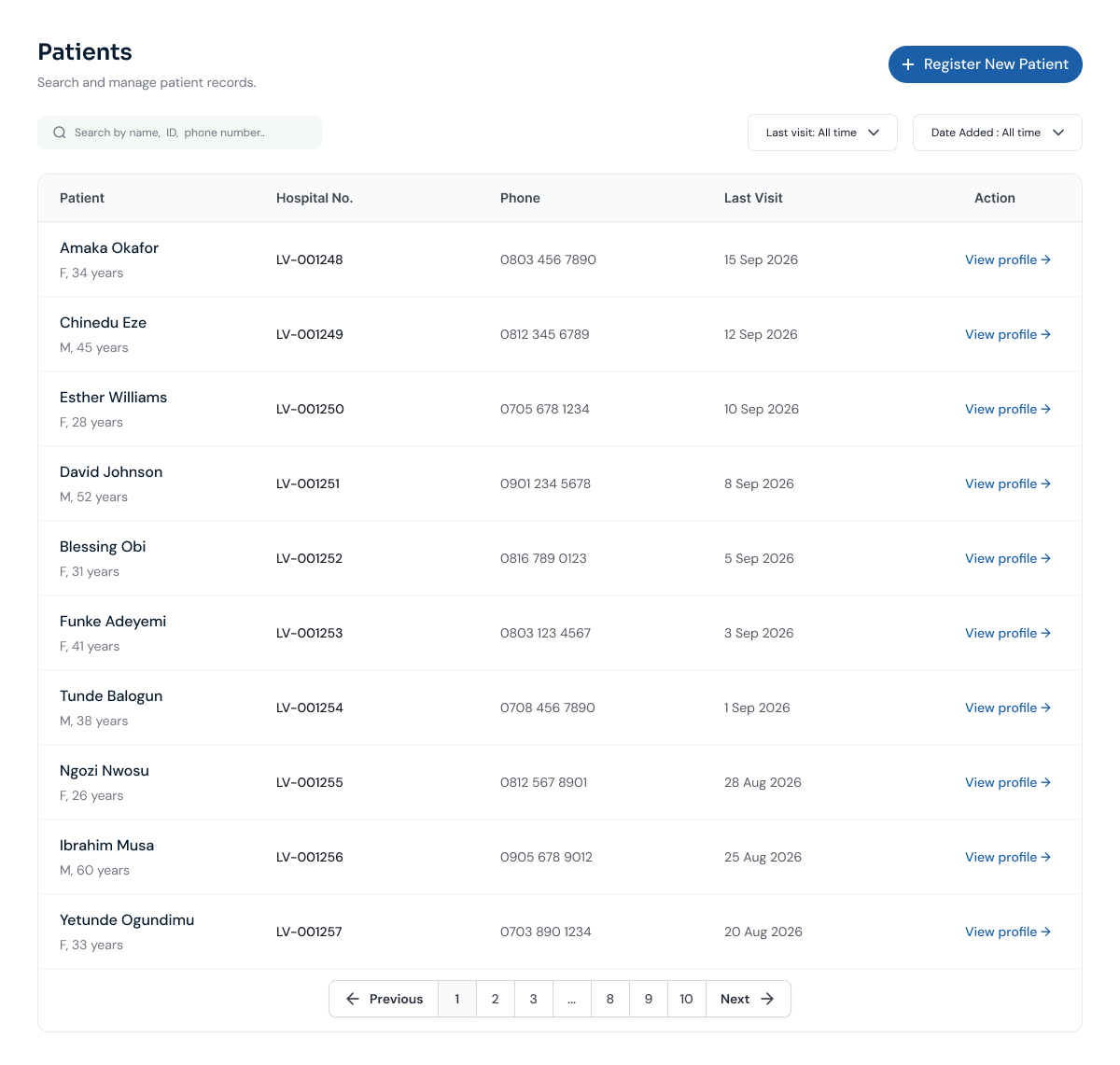
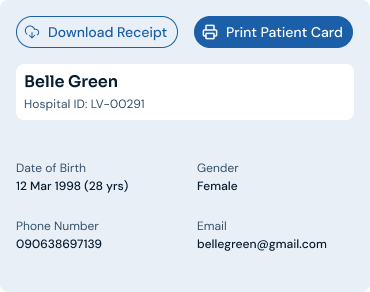
Amina Bello · F, 34
Full history · 6 visits · 2 referrals
Follow-ups
Patients lost between visits
Hypertension review today
Amina Bello · BP check
10:30 – 10:45Reminder sent
OCT
14
Operations · Billing & HMO
Claims compiled by hand · 3 rejected
Claim packet ready
Built from the patient's record
NotesLab resultsPrescriptionsInvoice
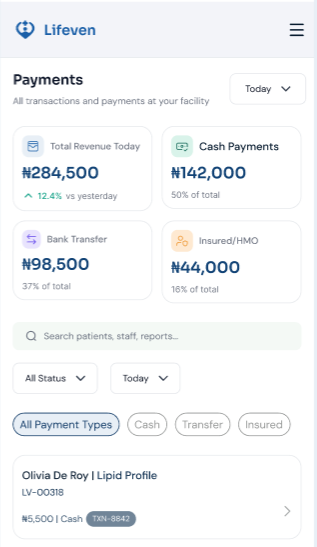
INV-1042 · Consultation₦15,000Paid
INV-1043 · Lab · FBC₦8,500Billed to HMO
INV-1044 · Pharmacy₦6,200Paid
Reports
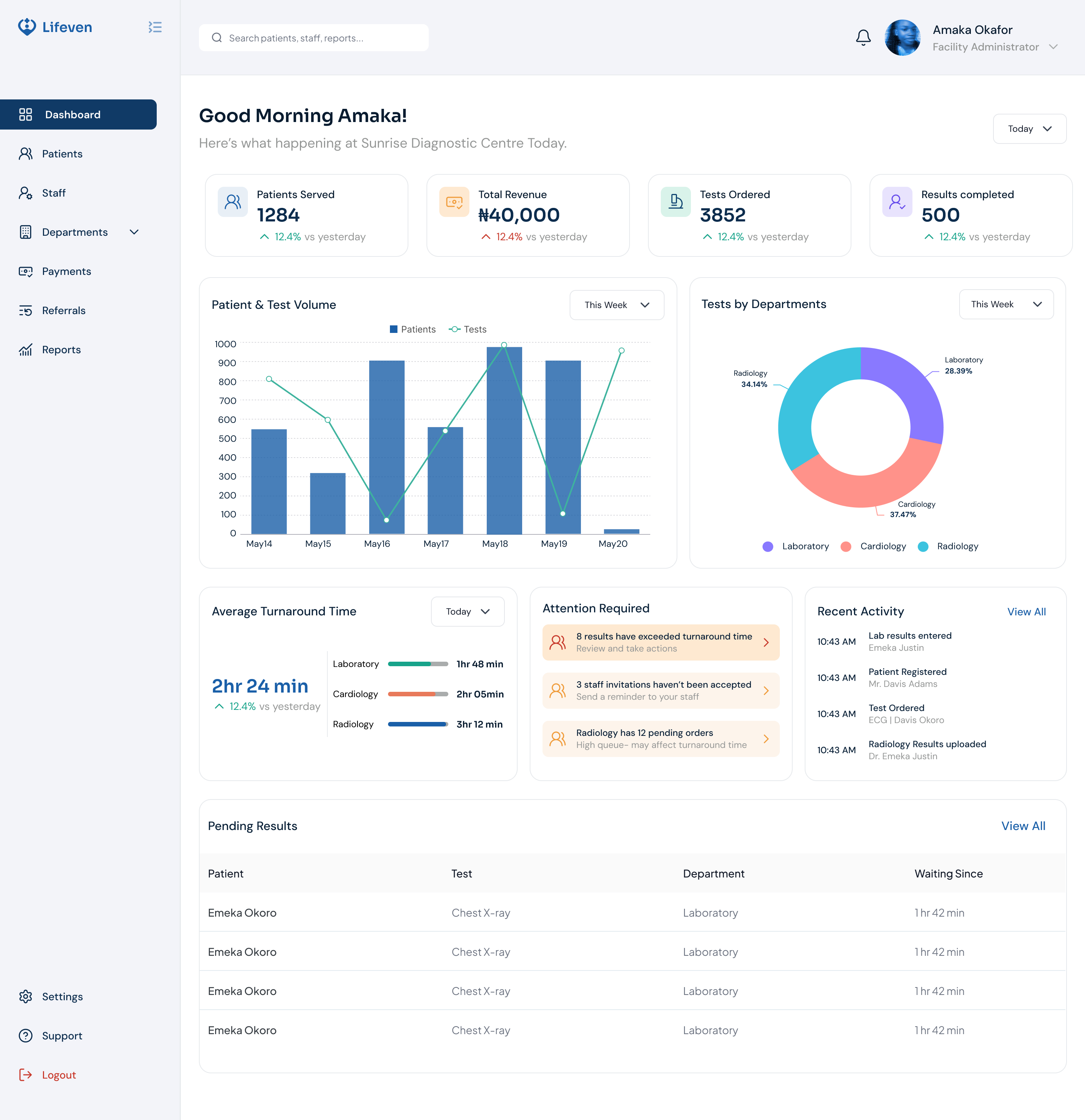
Hand-tallied, no real-time view
Revenue today
+12% this week
₦1,240,500
Patients served
48
Claims submitted
12
Top departmentLaboratory · 34%
Health Records, Ops, and Reports all in one place
Efficiently transition your healthcare facility from paper-based systems to a connected digital health platform, enhancing patient care and operational efficiency.
Paper records fade, get lost, or become untraceable
For patients
Records are lost between visits, tests get repeated, and patients incur extra costs and treatment delays.
For hospitals and clinics
Care continuity breaks and operational records are scattered. Services go unbilled, HMO claims are compiled by hand, and rejections pile up. With no payment visibility, revenue leaks, and stock ledgers rarely match what is on the shelf.
For diagnostic centres
Managing each patient's test queue becomes a nightmare, and tracking which referrer sent which patient, and what commission is due, becomes an error-prone monthly reconciliation.
Our solutions
Solve your health facilities biggest operational challenges
With any of our three deployment models, select the one that fits your facility's needs.
Level 1
EHR
Electronic Health Record
A core clinical record system for digitising patient information and supporting care.
LifevenOS brings patient records, clinical workflows, billing, HMO documentation, referrals and reporting into one system.
Clinical records that follow the patient
Registration, consultations, vitals, notes, prescriptions and results in one record, so every visit starts from what is already known.
Billing, payments & HMO claims
Every service recorded is a service billed, and claim packets assemble themselves from the patient's record.
Referrals & diagnostic workflows
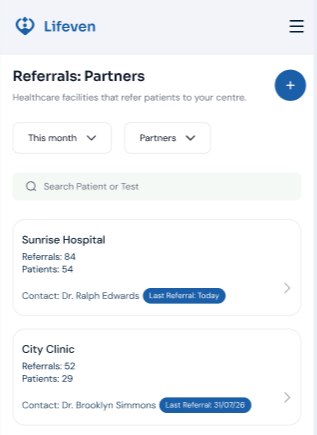
See who referred each patient, what was paid, and what commission is due, without the monthly reconciliation.
Reports & analytics, in real time
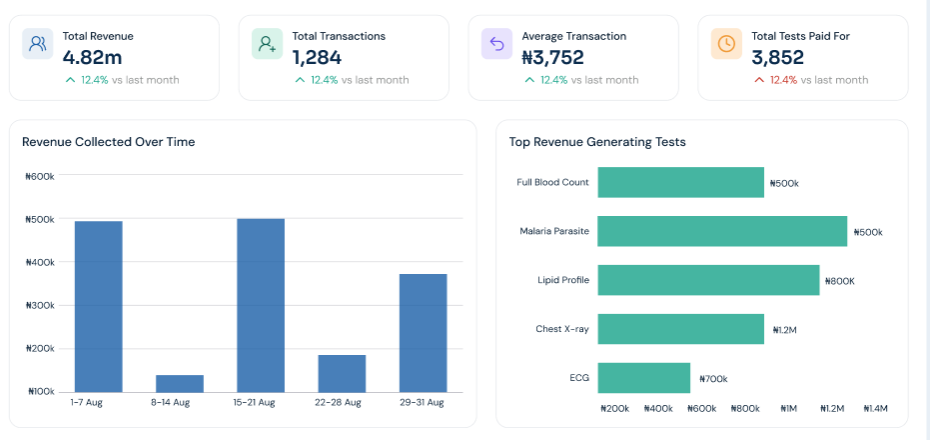
Patient volume, revenue and service performance at a glance, and data ready when a regulator, insurer or partner asks.
And much more
Appointments & queues
IPD & OPD management
Pharmacy & inventory
Laboratory & radiology
Staff & doctor management
Patient follow-up & reminders
Accounting & finance
Role-based access & backup
Get started in 4 steps
Up and running in four simple steps
From your first sign-in to your first patient, LifevenOS walks your facility through setup.
Deployment type
Works with your internet or without it
LifevenOS runs in the browser on smartphones, tablets, laptops and desktops. Choose the deployment that fits your infrastructure.
Offline-capable
Model A
On-premise
A local server inside your facility
Keeps working without active internet
Encrypted sync to a Nigeria-hosted backup when connectivity returns
Lifeven provides technical support
Managed hosting
Model B
Cloud
A secure tenant on the Lifeven cloud
No on-site server required
We manage hosting, backups, security and updates
New features delivered on a rolling basis
FAQ
Frequently Asked Questions
Our team will reach out to schedule a walkthrough of Lifeven Health. We'll show you the platform using workflows like your own (registration, consultations, billing, HMO claims, and reporting) and answer your questions about how it would fit your facility.
Small-to-medium private hospitals, clinics, diagnostic centres, university health centres, community and faith-based facilities, and through them, the patients they serve.
Yes. Most facilities we speak with are starting from paper, and the phased rollout is designed around exactly that transition.
Not all at once. LifevenOS works around your existing clinical processes and rolls out gradually, workflow by workflow.
Yes. Most facilities begin with a single bottleneck such as billing, claims, or follow-up, and expand from there.
The data belongs to your facility, not to us. Every deployment starts with a service and data agreement aligned with the Nigeria Data Protection Regulation.
Choose the on-premise model. It runs on a local server inside your facility and keeps working offline, syncing to an encrypted backup when connectivity returns.
If LifevenOS is the right fit, we map your workflows and infrastructure, configure the system with your clinicians, train your staff, and roll it out in phases. You can also email us at info@lifevenhealth.com.
Yes. After deployment, your facility gets a free trial period before moving to a subscription under an agreed pricing model.
Request a demo
Deploy Lifeven Health at your facility
Join the facilities that have transitioned from paper records to a digital health system, and get visibility over patient health records, your operations, and your finances. Tell us about your role and your facility, and we'll take it from there.